Friday, March 27, 2020

An Honorable Global Perspectives Quarantine Cinema Sound Off

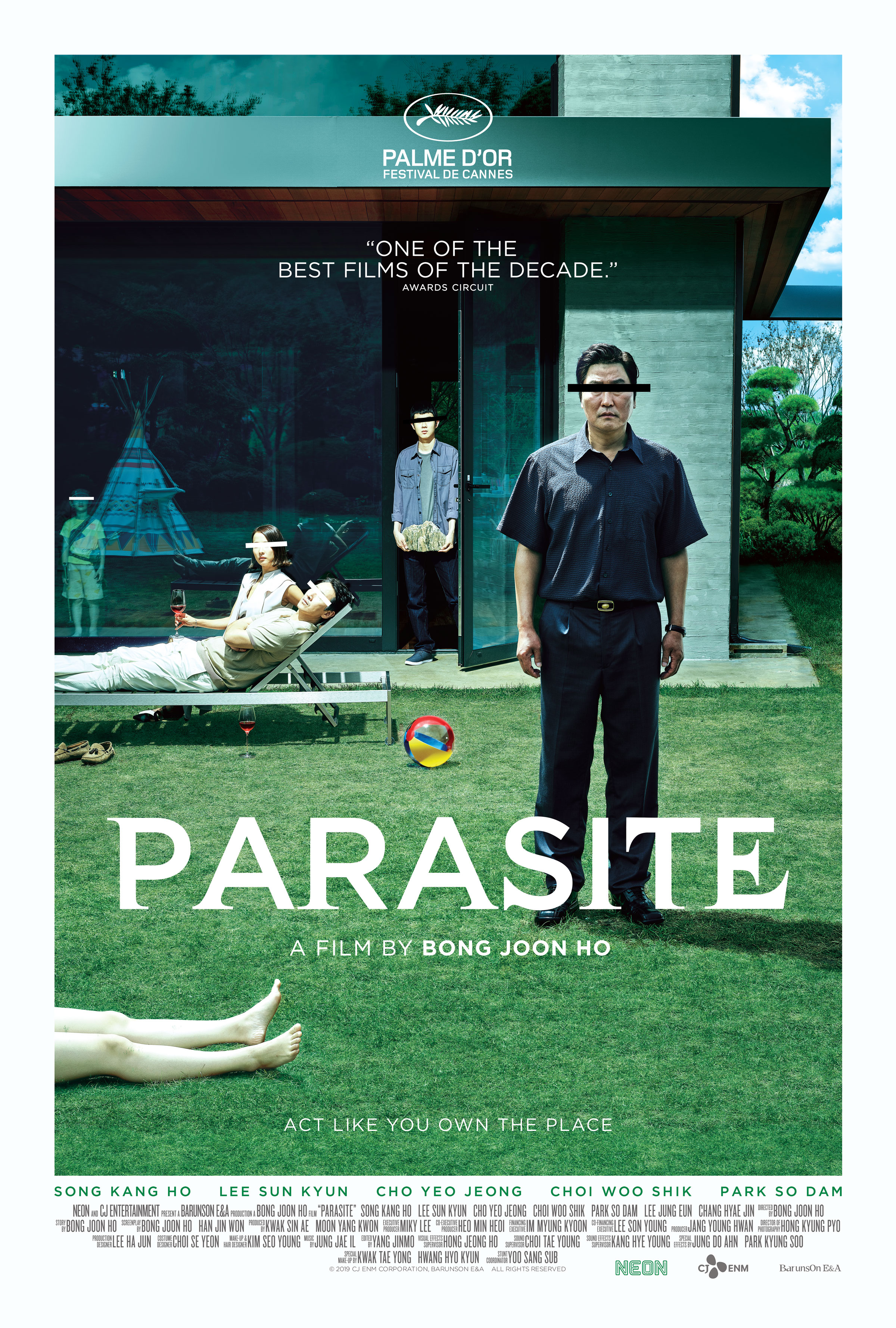
Parasite (2019) - IMDbWe were planning on hosting a public screening of Parasite, winner of this year's Academy Award for Best Motion Picture (the first foreign language film to win that honor) on Thursday, April 9th.

We can't do that now because of the Covid-19 shutdown, but the film is currently available on several streaming platforms for $5.99. So we invite you to watch at home (at your convenience) and join an Honorable online conversation in the comments section of this post.

Discussion starter: in what way does this film relate to any of the issues you've encountered in any of your Honors seminars
classes thus far?

How does the experience of watching a film like this at home compare to the experience of watching it in a theatre?

Whom do you empathize with most in this film?

What significance to do you attribute to the title? Is there more than one kind of parasitic behavior in this film?

If this film were adapted into an American context, would it change the film significantly if the poor family was African-American or Hispanic? What if they were immigrants? Would such a change supercharge the film's tensions? How would it affect the film's political impact? Is the film sympathetic to the poorer family or does it demonize them?

You are likely to have an immediate response to the film when you see it. Share that but also try to push through it. Let your thoughts simmer and come back to them later. If there are other comments, read and respond to them.

Wednesday, July 17, 2019

Honors Summer Read 2019: Rules of Engagement

"Woman Reading (Olga)," (1920) by Pablo Picasso.
Welcome to the ECU Honors Program's Enduring Questions website!  If you are enrolled in an Enduring Questions class for the fall semester of 2019 at ECU (EQ1 or EQ3), this website is for you.  Read on!

Responses to questions on this website are designed to generate "virtual conversation." By virtual, we do not mean something that looks like conversation but isn't. Instead, we mean REAL conversation in a virtual environment--this website.  And this fall, incoming first- and second-year Honors students will be engaged in the same discussion. Ten percent of each student's grade in both EQ1 and EQ3 will be based on your responses to the questions raised here.

The sort of conversation we're looking for is academic in character. Thus, your responses should consist of clear, concise statements of your ideas crafted in standard English (not text-speak!). They should be long enough to convey your thoughts, but short enough for other readers to read and respond to fairly quickly. In short, you don't want your responses to be so long that you monopolize (or kill) the conversation by going on, and on, and on.....(we all know how irritating that can be!).

Obviously, responses should not use profanity. They should be civil and respectful. People do not always agree. Responses can be critical; however, all communication is expected to be courteous and professional. Contributors' positions may be questioned; their character should not.

The object here is to reflect on some of the issues raised by the text, to connect the reading to your personal experience, and to help first- and second-year Honors students get to know each other better.

When should I begin posting my responses?
As soon as you have read the opening pages of Heartland: A Memoir of Working Hard and Being Broke in the Richest Country on Earth.

When is this assignment due?
This writing assignment is designed to be completed before classes begin in August.  Details about where and how to account for and submit your word count total will be provided in class when the semester starts.

How many questions should I respond to?
We do not expect you to respond to each question, but you should respond to several representing different sections of the book.

How much should I write?
Your responses should add up to a sum total of not less than 750 words.  Don't try to load up all 750 words into one or two comments.  You should also respond to comments left by other readers. And pose questions to other readers. (Check back later to see if anyone has responded to your comments-and respond to their responses.)  All of this writing will count toward your 750-word total.  Students are responsible for keeping track of their word total (you can cut and paste your responses into a Microsoft Word document, which has a word count feature).  This is not just a writing assignment, though; it's a reading assignment, too.  Every student is responsible for reading every word of the assigned text.

Where do I post my responses?
At the bottom of each question post, you will find a "comment" link. If it has a "0" beside it, that means no one has commented yet; as more people comment, the number will go up. When you're ready to weigh in, click on the "comments" button, read any previous comments, and start writing. Please sign your posts. And use your real name--not a nickname--so we can get to know each other).

More questions?
E-mail us at sbenton@ecok.edu!

Engaging Heartland

In this post, you will find links to several questions about Sarah Smarsh's Heartland: A Memoir of Working Hard and Being Broke in the Richest Country on Earth. These questions are identified by their page numbers and are listed in the order in which the issues they address are raised by the text.

There's also a sandbox where you can raise your own questions about the text that are not covered elsewhere (and answer those posed by others).

Once you've started reading the chapters listed below, click on the links, read the corresponding questions and comments other readers may have left (click on the "comment" button beneath each post to see them), and then join the discussion (or initiate it).

SPOILER ALERT:  Don't read questions before you've reached the page number associated with them.

Most posts have several questions. You may answer any of them you wish. It is not necessary to answer all of them.

There is only one question that every student is required to answer.  That's the last one, referred to here as "The Takeaway." Don't answer it until you've finished reading the book. Your answer is your promise that you have read the entire book.

As you are reading, underline any passages that you consider to be thought-provoking, insightful, or artfully expressed (unless you're reading a library copy, in which case, you may want to just make note). You may want to refer to one of the passages you have underlined in "The Takeaway."

A word of advice:  You might find it helpful to write down the names of the prominent members of the author's family to help you keep track of who is who in the family tree. There are some blank pages at the back of the book where you do do this.

Dear August (1-4)

A penny in a purse (5-43)

The body of a poor girl (44-84)

A stretch of gravel with wheat on either side (85-125)

The shame a country could assign (126-167)

A house that needs shingles (168-208)

A working-class woman (209-246)

The place I was from (247-289)

The Takeaway 
After Heartland

Tuesday, July 16, 2019

1: Dear Daughter

"Advice from a Caterpillar" by Arthur Rackham
On the first page of this book, Smarsh reports that when she was a kid, and she was "fretting about the sort of decision that in another household might have gotten help from parents," she used to ask herself, "What would I tell my daughter to do?" (1).

Imagine that you have a daughter who is fretting about going to college.  What would you tell her to do?
Assume that shorter answers have a greater impact.

Sunday, July 14, 2019

23: Flash Sale: Instant Wisdom! Satisfaction Guaranteed!

"Untitled (I Shop Therefore I Am)" (1987) by Barbara Kruger
Smarsh reports that in July 1979, President Jimmy Carter warned that American public that "Too many of us now tend to worship self-indulgence and consumption," but he also added that "we've discovered that owning things and consuming things does not satisfy our longing for meaning" (23).

Smarsh seems to agree about the dangers of worshiping the false idol of wealth, but she disagrees that the American people understood that material goods will not satisfy our longing for meaning.

It is common for people to deny that they value wealth, material gain, self-indulgence and consumption over other more traditionally virtuous goals.

But if you look at what people do as opposed to what they say, do you believe people today tend to value self-indulgence and consumption any more or less than previous generations of Americans have?

Is there anything about life today that makes the temptations of consumption and materialism less or more tempting than they were in the past?

25: Sheer Force

Wall art at Marble Arch in London (2019) by Banksy
Smarsh writes that when she was in junior high, she realized that her family's pattern of teenage pregnancy could only be ended by her own will.

Generally speaking, would you say that will power is the greatest force for change in the lives of most people in this country?

Or would you say that the force of will power is overrated because of the great impact larger historic and cultural forces have on people's lives?

Saturday, July 13, 2019

44: Your Power, Your Work, Your Value

Cincinnati Union Terminal (1993) by Winold Reiss
Smarsh argues that "'Blue-collar workers' have jobs requiring just as much brainpower as 'white-collar professionals'" (44).  To advance this claim, she points out that "To run a family farm is to be a business owner in a complicated industry" (44).

Work that involves hard, physical labor can be both "miserable" and "satisfying" (44).  What Smarsh does not like about jobs that require hard physical labor is that they are devalued by society at large, and, as she puts it, "A society that considers your body dispensable will inflict a violence upon you" (45). As examples of this violence, she refers to the high cost of healthcare, corporate violations of worker-safety regulations, and a legal system that favors those who can afford expensive lawyers.

Whether or not blue-collar jobs require as much brainpower as white-collar jobs, do you think jobs that require greater brainpower should be given a higher value and be more richly paid than jobs that require less brainpower?

Should jobs that require more effort--whether physical or mental--be given a higher value and be more richly paid?

Do you think our current system values work fairly?

Are the most valuable jobs the most richly rewarded?  If not, what could be done to change that?