 |
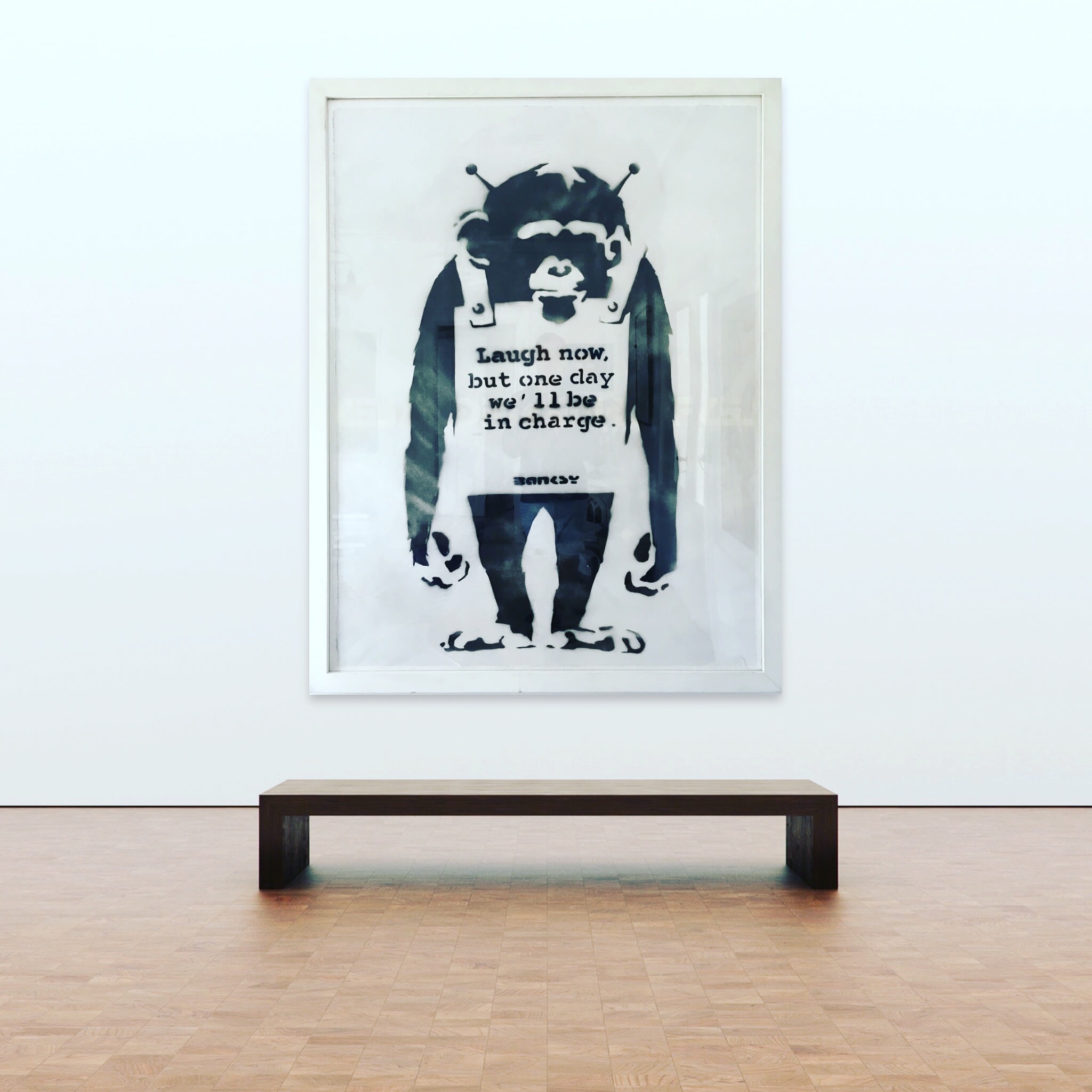
| "Laugh Now But One Day We Will Be in Charge" (2001) by Banksy |
192. As Lewis puts it, Kahneman and Tversky found that "Human judgement was distorted by . . . the memorable." If "misleading evidence came easily to mind, they made mistakes." As such, it might be the case that because emotional testimony is more memorable than statistics, it might be given greater weight than it deserves.
Similarly, a memorable image or a humorous remark might have more impact than an expert's report.
If an increasing number of people get their political views from social media, is our society doomed to become one in which emotion (humor, fear, anger) trumps reason, evidence, data and expertise? Is there any way to prevent such a development?
People are inherently emotional, even if they believe that their decision making is unaffected by their emotions, those emotions still exist. They may choose to ignore them, but they are there, and they do affect their line of thinking. That is why when political ads, or ads in general, are created they often present the opposition in some sort of demeaning light. As for reason, data, evidence, and expertise, even just looking at the past actions of a person or how their numbers differed from the other candidates can cause a stir in emotion. To reference another question, people aren’t robots, and they tend to fight against whatever it is that makes them feel that they are. So no, I don't think there is a way to prevent such a development, because it is already here.
ReplyDeleteGracie T.
I concur, the only way to reverse this process would be to make all news only factual and statistical but the vast majority of news sources are partisan and use quick jabs at the other party that have nothing to do with policy making such as Dr. Fauci not wearing a mask with his family during a baseball game or President Trump not being able to walk down a ramp. These partisan news sources paint the other party as the boogieman and use emotion to do so rather than beliefs and policy.
DeleteOur society, especially here in the USA, is spiraling down-hill towards emotion trumping statistics. It seems everyday the media pulls on our heart strings way more than it should or could if it just gave non-biased facts. This question actually reminds me of another book I read called "How to Lie with Statistics." The book talks about how stretching numbers, or giving approximations, or just using random control groups can make and obtain desirable statistics to fit almost any bias you want. It would take an almost inconceivable amount of effort for our society to make the 180 and go to facts first before emotion.
ReplyDeleteThe distribution of news on social media platforms has been a good and bad development in my opinion. I think that platforms like Twitter, Instagram, Facebook etc. has allowed for the mass transit of news in a very short amount of time. I can login to my Instagram and be updated in the blink of an eye on all kinds of news topics (ex. Sports, politics, academia, natural disasters etc.). The different outlets that each individual follows help give them a sense of unity with that publisher and other people who share the same thoughts as them. However, it is this limited exposure to different viewpoints that I think is the biggest danger when discussing the distribution of news of these different social media platforms. When following these platforms, we naturally chose ones that cater to our personal convictions or moral code. While this isn’t an inherently incorrect action it does limit your view and make you closed minded in a sense. I am not saying to go out and allow your convictions to be altered by watching/reading polar opposite things, however, I am saying that seeing different angles to a matter naturally allows you to be able to better express your stance in a more well-versed manner. The other problem that I have with social media news is that I think we as a generation have become too reliant on the creators of these pages. This reliance on other people for our opinion makes people more apt to respond emotionally when “their” view is challenged when in reality it really isn’t their view because they haven’t done the research for themselves. That’s why an individual should go and due research for themselves so that when challenged by an opposing view they can present why they disagree in a professional and collected manner.
ReplyDeleteEmotional Testimony is more memorable because we as humans feel relatively similar emotions, or can sympathize with them. Reflecting those emotions and sympathizing with them is far more memorable than reading statistics and numbers. I do believe that emotions are important in politics and should be taken into consideration facts of course have a more vital stance. From what I’ve seen of Gen Z and the next generation of people so I don’t believe that emotions will trump facts anytime soon, although they are being held into a higher regard than they were previously.
ReplyDelete